A replacement part is never just a replacement part
Why keeping solar assets operational requires more than finding the right component
Solar assets are expected to operate for twenty, twenty-five or even thirty years.
During that lifetime, components will fail. Inverters may need repair or replacement. Modules can suffer damage or degradation. Connectors, cables and other electrical components may require intervention. Original manufacturers may disappear and identical replacement parts may no longer be available.
Finding a replacement component can therefore be essential to keeping an existing PV asset operational.
But one point is often overlooked:
A technically compatible replacement component is not automatically the right replacement for the project.
The real question is what happens when that component becomes part of the system.
The asset has a history
A new solar project starts with drawings, specifications, calculations and product documentation.
An operational asset has a history.
Components may already have been replaced. Cables may have been rerouted. Settings may have changed. Repairs may have been carried out. Maintenance quality may have varied over time.
What exists after fifteen years may therefore differ from the system that was originally commissioned.
That matters when a component needs replacing.
Before selecting a replacement module, inverter or other component, it is worth asking:
What was originally installed?
Why did the component fail?
Is the failure isolated or does it indicate a wider problem?
Has anything else in the system changed?
Does the proposed replacement interact correctly with the remaining installation?
Replacing a component without understanding the cause of failure can mean replacing the symptom while leaving the underlying risk untouched.
Compatibility is more than technical data
Consider the replacement of a PV module.
Dimensions and electrical characteristics obviously matter. But so do mounting, connectors, cable routing, system voltage, string configuration and interaction with neighbouring modules.
The same applies to inverters.
A replacement inverter must do more than provide the required power output. Protection settings, communication, monitoring, grid requirements and the existing electrical configuration also matter.
The question should therefore not simply be: Does this component fit?
But: Does it fit safely and correctly within this particular system?
Used does not mean unsuitable
This becomes especially relevant as the market for used and refurbished PV components grows. SecondSol
A used component is not automatically a bad component.
In some cases, an original replacement module from the same generation may even offer advantages because its dimensions and electrical characteristics are closer to the existing installation than those of a newer alternative.
Repair and refurbishment can also help extend the operational life of an asset and avoid unnecessary replacement but condition matters, history matters, testing matters and suitability for the specific application matters.
The real question is therefore not whether a component is new or used. It is whether enough is known about its condition and application to make a responsible decision.
Why did it fail?
One of the simplest questions in asset management is also one of the most important:
Why are we replacing this component?
If a module has suffered external physical damage, the cause may be clear, but if connectors repeatedly overheat, an inverter fails prematurely or insulation faults continue to occur, replacing the failed component may not solve the real problem.
The underlying cause could lie in installation quality, system design, ventilation, moisture ingress, electrical loading, maintenance or a combination of factors.
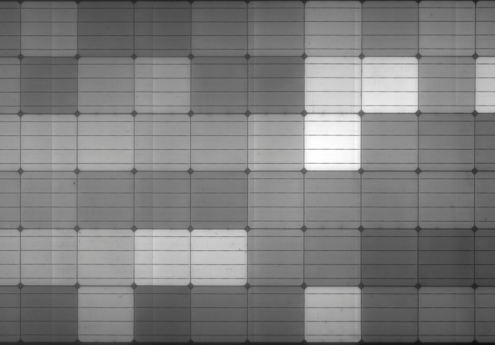
This is where inspection and diagnostics become important. The objective should not only be to identify what failed. It should also be to understand what that failure tells us about the rest of the asset.
De-Risking continues during operation
De-Risking does not stop when construction is complete. During operation, risks continue to develop as components age, environmental conditions change, equipment is replaced and maintenance is performed.
De-Risking means identifying those risks, understanding how they may develop and taking measures to keep them demonstrably manageable throughout the lifecycle of the asset.
That includes monitoring, maintenance, inspection, repair and replacement. Every intervention can maintain the original quality of the project, improve it or unintentionally make it worse.
That is why replacement decisions should never be viewed in isolation.
Documentation protects future decisions
Every intervention also becomes part of the asset’s history.
Was a module replaced? Record which one.
Was a different inverter installed? Document the settings.
Was cabling modified? Update the drawings.
Did an inspection identify a deficiency? Record how it was resolved.
This may sound administrative, but without accurate records an asset gradually becomes harder to understand.
After ten or fifteen years, several owners, asset managers, maintenance providers and technicians may have worked on the same installation.
If each intervention is treated as an isolated repair, knowledge about the system disappears.
And uncertainty increases.
When something goes wrong
Good documentation becomes particularly valuable after a serious incident. At that point, questions can become very specific.
What was originally installed?
Which components were later replaced?
Were they technically compatible?
Who performed the work?
Were inspections carried out?
What did monitoring show?
The better those questions can be answered, the easier it becomes to reconstruct what happened.
That matters operationally, contractually and potentially when discussing a loss with an insurer.
Documentation is therefore not just a record of the past. It helps protect the future of the asset.
Extending asset life responsibly
The solar industry is entering a phase in which maintaining existing capacity will become increasingly important alongside building new capacity.
Repair, reuse, refurbishment and targeted replacement all have an important role to play but extending the lifetime of an asset should never mean lowering the standard by which risk is assessed.
Every intervention is an opportunity to understand the system better, correct weaknesses and preserve reliability because the value of a replacement component is not determined only by whether it works when it is installed.
It is determined by whether it helps the entire asset continue to operate safely and reliably.
The right spare part keeps a component working. The right decision keeps the project working.
Author

Harry Wolkenfelt
Solarif Group
E-mail: support@solarif.com
Web: www.solarif.com
About Solarif
Solarif Group is an international specialist in De-Risking solar PV and battery energy storage projects through risk management, inspections and insurance.
Solarif supports project developers, asset owners, investors and other stakeholders in identifying, managing and transferring risks throughout the full project lifecycle.
For Solarif, De-Risking means identifying risks early, understanding how they may develop and interact, and taking measures to keep them demonstrably manageable throughout the lifecycle of a project.
By combining technical risk expertise, inspections and insurance knowledge, Solarif helps make solar PV and battery energy storage projects more insurable, financeable and operationally stable.